
© Depositphotos.com/[kateholms] – Terms and Conditions
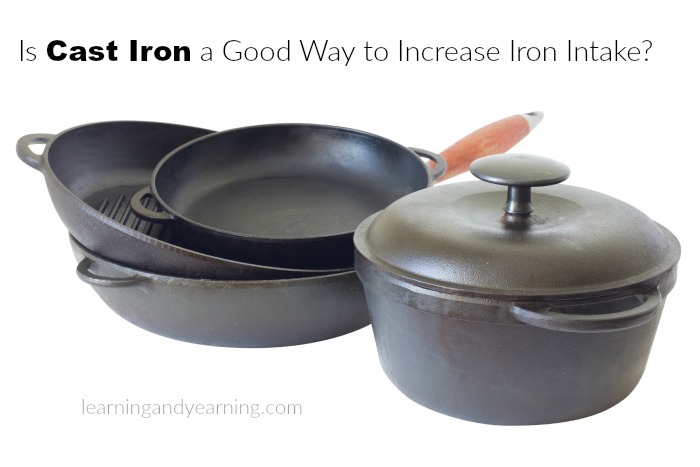
Anyone who has used a well seasoned cast iron pan knows how wonderful they are for cooking, especially for braising and for stews. And knowing how toxic it can be to cook with most non-stick pans, cast iron again looks like a good choice. Article after article touts the added benefit of increased iron in your foods. But, are cast iron pans as safe as they have been made out to be, and are they really a good way to increase our iron intake?
Organic vs Inorganic Iron
To answer these questions we must first understand the different forms of iron and how our body utilizes them. Iron, like all minerals, has two forms – organic (heme) and inorganic (non-heme). Both forms of iron have the same chemical composition (Fe) but how they are utilized by our bodies are not at all the same. Iron which is found in the soil is inorganic. Plants are very efficient at transforming this inorganic iron into organic iron, a form which our bodies can more easily use. The meat from animals which eat these plants contains organic iron, and is even better utilized by humans than plant sources.
It’s Proven that Cast Iron Increases Iron in Food, But Can We Absorb It?
In 1986, a test was conducted where foods were cooked both in cast iron and non-iron pots. 90% of the foods cooked in the cast iron had significantly more iron in them (up to 20%) when analyzed than did foods cooked in the non-iron cooking utensils. Foods high in acid contained the most iron when cooked in the cast iron. Most articles that promote the use of cast iron proclaim this increase in iron in the food as a benefit. What the study did not address was whether the iron was able to be absorbed into the blood stream in a functional way.
Problems With Inorganic Iron
When inorganic (non-heme) iron is ingested the best case scenario is that it will be eliminated in the stool. This is why inorganic iron supplements turn the stool dark and often cause constipation. Our bodies cannot easily break down this form of iron because it is a metal. Organic iron (heme), on the other hand, does not darken the stool.
Any inorganic iron that is not assimilated or eliminated will remain unused in the body’s tissues. These deposits can lead to disease such as kidney or gall stones, arthritis or hardening of the arteries. While studies show that inorganic iron can be absorbed into the blood stream, this process is not without side effects and cautions. It is extremely important that the stomach contain acid to dissolve the iron. Iron supplements may interfere with other medications and many foods inhibit the absorption of the iron. The supplements are toxic to children and extreme care must be taken to keep them away from little ones. Gastrointestinal side effects are common and can cause irritation and make colitis or Crohn’s disease worse. Excess iron from supplementation can even cause organ damage. Remember, the form of iron in these supplements is inorganic (non-heme), the same form of iron found in cast iron pots and pans.
But I Love My Cast Iron
I have been a huge fan of cast iron for years. We were given old pans years ago and they are so well seasoned that nothing sticks and clean up is a breeze. I also enjoy cooking in our cast iron Dutch oven outdoors at our cottage. I have been wondering, for too long, if this is really a good form of iron for our body and if using the pans as much as I do is a good idea. So I have finally been researching and have asked my nutritionist about it. She says that “inorganic minerals displace organic minerals at receptor sites and must be detoxed before being replaced with organic minerals”. Yes, I’m groaning. Asking me to give up my cast iron is like asking me to quit coffee. (Yes, my nutritionist thinks I should do that, too. She otherwise heartily approves of my food choices).
So, what will I do? Will I totally give up cooking in cast iron? The 1986 study I mentioned earlier had one bit of good news. Foods cooked in well seasoned cast iron increased in iron at a much lesser amount than those cooked in cast iron that was not well seasoned. Phew! So, I will use these pots less. I’ll still use our Dutch oven at the cottage once or twice a year. And I’ll stop using cast iron if the food has tomatoes in it (I liked to make chili in my cast iron), or anything else acidic since the highest amount of iron was found in acidic foods. I’ll wean myself. Baby steps, right?
I do have stainless pots and pans and I’ll be researching what else I can use. I like the idea of enameled cast iron. What kind of pots and pans do you use?

Sources:
http://www.irondisorders.org/supplements
http://ods.od.nih.gov/factsheets/Iron-HealthProfessional/
Iron: The Most Toxic Metal
http://whatscookingamerica.net/Information/IronCastIron.htm
Sources updated 9/27/13
Thank you for visiting Learning And Yearning. May "the LORD bless you and keep you; the LORD make his face shine upon you and be gracious to you; the LORD turn his face toward you and give you peace." Num 6:24-26
Deborah Hamby says
Bummer. We just started using cast iron again, thinking we were doing a good thing. Thanks for posting this. Guess I’ll be shopping around too!
Jani says
Don’t give up your CI and don’t give in to the latest hype. CI is better than anything. Seasoned properly and used properly you minimize the affects they are claiming. Stainless is your next best option and anything with a coating of anything un-natural should be abandoned. Cast aluminum, while great to cook in should be minimized or abandoned until they determine if in fact aluminum is the cause or part of the cause for Ahlzeimer’s.
Like everything, moderation and common sense must prevail.
Bottom line…let’s put it in perspective…which is worse? CI or Fast Food?
I’ll take home cooked in CI any day over Fast Food of any sort!
eric76 says
I am always amazed that people think that Aluminum causes Alzheimer’s because of some report that appeared on Sixty Minutes more than 20 years ago. The notion that it causes Alzheimer’s or other dementias has been disproven about as much as anything can be disproven.
On the other hand, excess iron in the body is a very real concern — one that convinced me to give up using cast iron cookware more than 20 years ago. I’ll cook with aluminum any day, but give me regular cast iron cookware and I’ll throw it in the trash.
If you must use cast iron cookware, go with enameled or clad cookware that keeps the food separated from the cast iron.
Yvonne says
Aluminum is toxic, plain and simple.
Golden says
Aluminium reacts with many foods to create hydrogen which is used in literally every molecule of the body. I honestly think the Alzheimers thing is a load of crap. Teflon is the only cookware that really scares me!
Marakov says
I’m with Jani on this one. I’m sticking to my CI which I ensure are well seasoned and cared for. As Jani also mentions about Fast Food, CI is what got me and my family off the habit of eating out so much. I now enjoy cooking each day and my family loves the eating what I cool! 🙂
Cindi Hepner says
I have Cast Iron and Stainless Steel Cookware… I use both 🙂
Mike says
Both aluminium and iron(cast or normal) isnt healthy in the long term. Aluminium for reasons above mentioned and iron because it oxidises fats in the food (heating already does this but iron utensils add to it and turns them rancid. And that is unhealthy for the heart.
Teflon and ceramic are very unhealthy too if they start getting peeled off. Stainless steel leaks nickel and chromium into the food. But a particular kind of stainless steel is okay.. …304 grade stainless steel. Or good old brass utensils.
Teflon or ceramic is okay but only until they havent developed scratches. If they did its better to throw them . Its important that we use wooden spoons no matter which metal or material the utensil is made of. As they are less likely to peel or scratch off the metal. they did its better to throw them away.
EVO 'n' OVE says
We use all glass cookware and it is awesome!
Linda @ Axiom at Home says
Great information! It is such a challenge trying to figure out the right way to go, every bit of information helps.
Cincy_Sensei says
How many read Susan’s sources, critically? Who read Susan’s article – critically? Put the brakes on the shopping! Susan’s article is not ‘wrong’, but it IS wrong to believe the message is cast iron cookware is ‘bad’ for you! SS cookware can release Nickel (VERY small amounts associated w/vigorous action of metal utensils) which is FAR more toxix. Aluminum…greater dosage than nickel from SS…& FAR more toxix than iron. Well-seasoned cast iron is safe, releasing SMALL amts of Fe in non-acidic foods. The bad effects of excessive iron (Sec. 4) is associated with studies of persons taking supplements (pills containing inadisavbly high dosages of inorganic iron)! For Fe to block receptor sites (Sec. 5, para. 1, Line 6) says inorganic iron WAS absorbed. Fe cannot be ‘detoxed’, it is removed, over time, by metabolic processes (fasting {read the sources}, physical activity, pure water). Ceramic cookware can be toxic, beware the bright flashy colors of ALL cookwares. Lead (as in the INORGANIC metal) in glazes/paints/colorations enhances color transmission – why toys & charms from China are so often targeted by the consumer safety regulators.
Cincy_Sensei says
Sorry: toxix s/b toxic – dang spellchecker ;)). One of Susan’s source articles state that even when not metabolized, high (er) amounts of Fe in the bloodstream (in blood is not same as metabolized)
has can have an ‘energizing’ effect. ?? who knew?R. King says
THANK YOU!
Kari says
I have been wondering about Stainless Steel because most of them have aluminum in between two layers of stainless steel. I know aluminum isn’t good for your health, so I have been wondering if the aluminum gets out at all during cooking. Anyway, thanks for the article about cast iron. Definitely a bummer. I agree with the baby steps.
susanv says
My understanding is that the pots are safe since the aluminum is sealed in between the two layers.
Natalia @PrepUtilityVehicle says
Most stainless steel is not really safe either apparently. It releases nickel which can build up and cause toxicity, with hard to diagnose symptoms.
Adriel says
My understanding is that you want a higher quality of stainless steel and that there are actually different grades available. Don’t purchase the “cheap” stainless steel alternative.
Considering that Cast Iron skillets and pots have been used successfully for generations, I believe I will continue the use. The safety CI far outweighs the safety of nonstick pans or enameled pans because if the coating is scratched at all it can cause small bits of the coating to flake off into the food. I personally avoid those as much as possible.
Anyone ever consider why there was a lower percentage of anemia cases during the depression? Perhaps from the use of cast iron pans for cooking beans and other such foods?
roger says
I just recently read this blog about thinking twice before using cast iron cookware. I found your information interesting but without a great deal of complete science. How much iron do I need? I too am sticking with cast iron:
If you have already been diagnosed with iron deficiency, talk to your doctor or healthcare provider about treatment. For healthy individuals, the Recommended Dietary Allowance (RDA) for iron is listed in the following table.
Recommended Dietary Allowance (RDA) for iron by age and sex.
Age/Group Life Stage Iron (mg/day)
Infants 0–6 months 0.27*
7–12 months 11
Children 1–3 years 7
4–8 years 10
Males 9–13 years 8
14–18 years 11
19–30 years 8
31–50 years 8
51–70 years 8
>70 years 8
Females 9–13 years 8
14–18 years 15
19–30 years 18
31–50 years 18
51–70 years 8
>70 years 8
Pregnant Women 14–18 years 27
19–30 years 27
31–50 years 27
Lactating Women 14–18 years 10
19–30 years 9
31–50 years 9
Cooking with cast iron three times per day will not reach these levels which is also why individuals need to eat iron rich diets. Too much iron? Hemochromatosis: Iron Storage Disease: This affects about 1.5 million people in the United States. I spoke with the CDC about your blog and got some answers which brings concerns to your post of cooking with cast iron: First, the amount of iron received in absorption from cooking foods in cast iron is not high enough to be concern. Individuals with Hemochromatosis should not take iron pills, supplements, or multivitamin supplements that have iron in them. Eating foods that contain iron is fine. Including cooking with cast iron: Exercise: This is a good thing for anyone regardless of age but everyone also needs to exercise not less than 30 minutes per day increasing heart rate and breathing. No matter how organic or non organic any life style is, cast iron cookware is NOT the medical concern. For further studies, check with the CDC, John Hopkins medical Center, USDA because your blog jumps to conclusion: Sure cast iron cookware will allow some absorption of iron into foods: However, a person with hemochromatosis should be concern to the following: Recommended guidelines…
?
Follow your doctor’s advice about the need
for bloodletting or phlebotomy. Trying
to control iron overload with diet alone may be dangerous when you have
hemochromatosis.
?
Avoid iron, multivitamins with iron and Vitamin C supplements.
?
Limit alcohol intake. Avoid alcohol entirely if you have liver damage.
?
Limit portion size and how often you eat
organ meats, red meat and shellfish.
?
Avoid cereals with high levels of added iron. Choose those with wheat bran.
?
Drink tea with meals. Add wheat bran or flax meal to baked goods.
?
Eat plenty of fruits and vegetables. They contain antioxidants which help protect
your cells from being damaged by the excess iron.
?
Avoid raw fish and shellfish, and follow safe food handling rules. Having
hemochromatosis puts one at greater risk for bacterial infections of the blood.
Willom Samuel says
I’ve been switching to ceramic coated pots and pans. I have cast iron and stainless steel pots and pans coated with ceramic. They’re practically non-stick, too.
susanv says
Yes, yes. That’s what I need to look into. I said enameled in the post, but I think ceramic is what I should have said.
Beth @ our front porch view says
Very interesting!
I had a feeling about cast iron dangers, but thanks for doing the research 🙂
We use Cutco Cookware (same makers as the amazing cutlery)… They are stainless steel with and aluminum core… so they are surface-safe and heat evenly.
They are also “waterless” cookware so we preserve a lot of nutrients by not having to boil fruits/vegetables to death. I love them!
Thanks for this post!
A Young Family’s Pursuit to a Life of Simplicity & Contentment
www.ourfrontporchview.blogspot.com
Tami Lewis says
thank you so much for this article!
Allison says
This was a very informative post! Thank you. Since we take vitamins made from whole foods sources for maximum bioavailability, this makes a lot of sense to me. We currently use stainless steel and I have one small pot that is enamel coated SS. Love them both!
Andrew says
Your penny isn’t copper…
That said iron bioavailability and bio-absorption are two different things and vary person to person. One would expect the majority of cast iron bits to pass in the stool and as long as you’re well hydrated and somewhat active you’ll be fine.
Rachel Ramey says
We largely use SS here, too (the multilayered “waterless” stuff that has an aluminum core). I have a cast iron skillet that I use when it needs to be “bakeable” – like if I’m making cornbread or something that needs to go into the oven. Those sorts of things are generally the only times I use it. (It’s HEAVY, and I’m tiny, so health issues aside, I prefer not to use it!) Oh, and glass – we use glass for baking. (It’s not as good for on the stove, because some vitamins are lost through access to the light during cooking that are better-retained if they aren’t exposed to the light. ‘Though it’s still better than aluminum or something.)
I’d love a ceramic coated electric skillet, but they don’t seem to be making those yet.
Laura West Kong says
I’m in the process of switching out all my cookware to really good, hopefully safe ones. I have one All-Clad SS flat bottomed wok that I absolutely adore, one blue steel omelet pan that’s wonderful too, but i wrecked the coating and it need reseaaoning, a couple anodized aluminum, they stick more than SS.
I don’t care for the nanotech ceramic “green” nonstick at all, besides its safety is not completely proven. At first food slides around in a really bizarre way as if the pan is actually repelling the food, you can’t really get a good sear, the coating is quite fragile and now food sticks like crazy in the center of the pan where the flame hits. It’s like nothing I’ve ever cooked with, and not in a good way.
Next on my list is an enameled pot like le Cruset, not the Chinese-made ones which im scared are lead-contaminated and possibly worse. And I have my eye out for good deals on more All-Clad. I was also wanting a cast iron skillet, but unless I can get my hands on a really well-seasoned old one, I’ll probably pass. I’m just not that patient.
Thanks for giving me something to think about.
susanv says
Can you site the studies for me, Lisa? Especially the studies that show that people who use cast iron are healthier. I love my cast iron and would be happy to be wrong.
Jenni Mullinix says
I really like using my cast iron as well. Interesting info… Thanks for sharing!
Buttons says
Wow I did not know that I love my cast iron. You have given me a lot to think about and choices to make. Thank you. B
Lisa @ Two Bears Farm says
This is great information to have!
Caro says
Very informative post ~ well researched ~ (A Creative Harbor) ^_^
Sue says
Fascinating post! I use cast iron. It seems it’s time to look into stainless!
Sandra at Thistle Cove Farm says
Love my cast iron and my enameled cookwear but not so much the teflon covered. moderation in everything.
visiting via Rural Thursday blog hop…
Jen says
This is one of those things that I am tucking away in the back of my mind for now. I am not convinced that my SS pans are the best option and I can’t afford to buy ceramic. So I am sticking with my cast iron for now. But this does give me something to think about. Thanks for bringing this up!
susanv says
Be diligent in keeping it them well seasoned!
Jen says
This I do already. 🙂 I am featuring this post on FF this week. It’s thought-provoking for sure!
susanv says
Thanks, Jen!!!
Dona says
I have been chronically anemic and had to take an iron supplement all of my life, especially around my cycle and if pregnant. My symptoms included dizziness and overall weakness. I started using cast iron about 10 years ago and ever since then I have not needed an iron supplement. I know for a fact that my body is able to assimilate the iron. I am not constipated nor do I have black stools. I started using cast iron because I was tired of replacing my pans every 6 months and I had heard that the non stick coating that cracks and peels was toxic. I was very surprised to feel the difference and realize that I no longer needed to take supplements.
susanv says
Very encouraging! Thanks for sharing your story. It does make me wonder, though, about people who don’t need iron, or who already have too much iron. I’ve had tests that showed too much iron and I’ve never taken an iron supplement. Could it be the cast iron?
Elizabeth Kirk says
Were you ever tested for hemochromatosis? This is a hereditary disease that causes your body to hold onto iron.
http://www.mayoclinic.com/health/hemochromatosis/DS00455
Susan says
No, I haven’t, Elizabeth.
wmtipton says
I use cast iron numerous times a week and have never had a problem either.
If I had black stools my first concern would be more about blood than iron.
And teflon, yes, is toxic. They have found it in peoples bloodstreams where the coating starts flaking away as it always does and gets ingested along with your food. Not to mention the problem with the toxins released if its ever overheated.
I’ll stick with cast iron.
Adriel says
Amen.
Dona says
I so agree with you.
Lauren @ Empowered Sustenance says
This issue has never even crossed my mind until now! Thank you so much for bringing it to our attention! I have one cast iron pan that I use daily, but I think I will start saving up for a ceramic coated pan (or ask for it for Christmas!). Great article!
A. States says
I agree with you. I have quite a collection of cast iron pans that I use on a daily basis. Most of which are from the early 1900’s. I have four dutch ovens, well seasoned and newer, for use at our cabin. I have always known not to cook anything acidic in them. I do have a set of stainless steel that is used when I need a stockpot or need to cook something acidic. No one in my family has an issue with dark stools, etc. I would trust my cast iron over anything else.
Polly says
Interesting article. I use stainless steel pots, not iron (asides from the cost I find them unwieldy due to the weight), and recently bought some ceramic-coated bakeware (bread-pan, cake tin and muffin tray). I’ve been really encouraged by the results: the food cooks well and comes away easily; something I’ve had difficulties with with other types of bakeware. I also use glass or ceramic a lot in the oven, and have found they work fine.
Lynnette says
I work in a store that sells pots and pans and always wish I was more informed. I only use SS and wanted to use cast iron more. Never buy the cheap cast iron that we sell from china. I would think an old seasoned piece to be safest. I can’t lift the weight daily anyway either. Is there a list of the SS that has nickel because I use 2 different sets at home?
susanv says
I’m not aware of that info, Lynette. This link may be helpful: http://www.nickelinstitute.org/en/HealthScienceEnvironmentalScienceAndSafeUse/ProductUseAdvisoryNotes/~/media/Files/HealthEnvironmentSafeUse/AdvisoryNotes/EN/AdvisoryNotesCookwareA409rev.ashx
Ron says
Flea Markets and rummage sales are the best place to buy well seasoned cast iron. We use them every day. Look for Griswold or Wagner. I agree, we don’t use them for acidic foods. Our nutritionist highly recommends them over Aluminum of Stainless.
wmtipton says
Id cook my food on the hood of my car before ever using aluminum again.
I over boiled water some years back in an aluminum pot and it ended up with this really funky gray ‘foam’ all over the top with something floating in the foam surface.
Never again.
Susan says
Having the same formula, Fe, does not mean that that all forms are equally bioavailable. Let’s use copper as an example. Copper from liver is available to our bodies. Scraping an old copper penny and ingesting it is not. But both are copper.
Richard says
Tell Lynnette if it’s Stainless Steel it has Nickel in it…
I am not too fond of using S/S because of the nickel content !!!
ana says
Greetings. thank you for interesting post.
But my concern is that it giving out some information as if there is really a great risk in using cast iron but you are not really offering any distress or harm that has resulted from using cast iron.
your nutritionist may be telling you ONE fact amidst a flux of complicated mechanism that do not follow a simple outcome: if i use cast iron pans, there will be inorganic iron excess in my system leading to such and such.
My Dr. she is a master chinese acupunturist, herbalist,and nutritionist (as well as MD) recommends cast iron pans as a safe tool for cooking.
I think there may be some cases were people are very sensitive and may have problems but this is probably an exception and not the rule.
sangos says
See a contradictory article below
http://www.ehow.com/about_5292375_iron-castiron-pans-absorbed-body.html
wmtipton says
Just one more reason I stopped paying attention to every ‘warning’ on the web.
I had a rabbitry for years and never had a single rabbit die of fear. But I read an ignorant article by some nut who said that if a rabbit gets ‘startled’ they can snap their own spine so be very careful about walking up on them too quick.
Yawn.
If that were the case rabbits in the wild would be dropping dead the second a bird of prey, or a dog, or cat, or whatever….even came up on them and ‘startled’ them.
Ive read data from both sides of the issue on cast iron and while its all interesting to read, the FACT is that people have been using cast iron for centuries to cook in and living to ripe old ages doing so.
I’ll keep using my cast iron that I bought to replace toxic teflon when I need a non stick surface.
The fact is we arent cooking on the surface of the iron anyway. If the pan is seasoned correctly you are cooking on a coating of carmelized fat.
I know this for a fact because I can take a cast iron pan that is not blackened by carbon at all, give it ONE coat of carmelized lard so that the fat hardens on the surface..and then watch eggs and rice slide around in it like an ice skater.
People think that its the blackened carbon that makes cast iron non stick, and while it ‘helps’ it isnt the biggest reason for the non stick surface….its the hardened fat on the surface that makes it non stick.
wmtipton says
I pretty much only use my cast iron to replace the poisonous teflon pans I used for years.
Frankly Id rather have a little extra non absorbing iron in my system than the toxic byproducts of cooking with overheated teflon any day of the year.
What I dont do with Cast iron is cook anything liquid. Not because of fear of a little iron, but because it stripped down all that seasoning Ive put time and energy into creating.
Ive no intention of ever giving up cast iron because there are a LOT of people who have been using them for every meal for a very long time who have lived far longer than I have any hopes of living.
Michelle says
LOL, me too!!!
Gia says
Hi – I’m super anemic (I eat plenty of grass fed meat etc) and take an iron supplement – Shaklee. Is this not the right form of iron? How can I better absorb the iron I am eating then (I do get enough Vitamin C).
Thank you!
Wendy Kever says
Mercola Cookware claims to be better than all these others.
http://cookware.mercola.com/ceramic-cookware.aspx
Nathan Birchenough says
An excess of bioavailable iron is dangerous. That’s why iron supplements are dangerous for children. Both iron supplements and organic sources contain bioavailable iron. It’s true that there’s a difference between eating iron supplements and eating plants or animals, but this is because the absorption of iron supplements is less efficient. Any iron which isn’t absorbed leaves the body in stools – not dangerous at all. However the body isn’t able to totally shut down iron absorption from the gut if you eat excess iron, which is why children shouldn’t eat iron supplements. But getting an excess of iron from cast iron cookware is so unlikely it’s not worth considering.
Pat H. says
I know that some people worry about aluminum pots. We had them in the family.
Only one person got Alzheimer’s. My father and Uncle Bob worked for Alcoa. They
never got Alzheimer’s and had all their mental smarts to the end. They had dirty
factory jobs at Alcoa where they breathed in aluminum dust. If aluminum was the
cause of Alzheimer’s, then every former Alcoa employee would have gotten Alzheimer’s.
There would have been plenty of law suits and settlements by now.
I say that we should enjoy the well seasoned cast iron pots, but stay away from the acidic foods. It’s important to be an informed consumer and play by the rules. I consider cast iron pots to be the original black pans without all those chemicals. I am glad to see that ceramic lined pans are back in style. I just bought a T-Fal, Forte line, ceramic lined pan. I seasoned the pan with some olive oil. I made an omelet this morning and was able to flip it with ease. Nothing stuck .
I think that I would buy a ceramic lined cast iron pot in the form of a dutch oven.
But, I would not buy one made in China. I am happy to see an interest and return to more natural materials. I also have Farberware stainless steel pots and Corning Ware dishes that I enjoy. So, you do have safer choices out there. Be an educated consumer.
d says
Hi folks! Heres my take. As an ex welder/fabricator. I can tell you this much. All stainless steal has impurities in it. Thats why they call it stainless. There is no way of totally avoiding all toxins. No way in hell. Everything in moderation. However I can tell you this much. Take your cast iron pan and wash it with a wet lemon. Leave it to dry for a day. Look and see how much rust develops on it. If it is pretty rusty thats a simple sure sign to give you an idea of the iron in it. If it doesnt show alot wet it with water then let it sit for a day. When you see the rust it will give you an idea. Dont forget if you use a citrus soap on cast iron pans you should dry it and rub coconut oil all over with a small cloth after washing it and for heavens sake try to start using plant based soaps so its easier on our environment. Non of this chemical Palmolive crap with sulphates and parabens. Plant based people. I would never stop using cast iron. Never. Again everything in moderation. Who are we to think that we tell our body what to do. We control what we put in it to a certain degree but we also do have some pathways to detoxify. Main thing to consider for an everyday routine is what you put out in the environment will come back at you or get into you. But for now I wouldnt be worryign about CI pans too much. Please take care of each other. I facking love all of you out there. Big Hugs.
Mel says
Do you have any information re the safety of using cast iron pans manufactured in China as opposed to Lodge in US?
sadie says
I am a cookware expert and a health nut. I wouldn’t want to cook on anything that leaches even a little bit of any heavy metal or toxin, because a little over time is a lot. I strictly use Saladmaster (it’s been around for 68 years and manufactured by Regal Ware which has been around for 100 + years). It is made of the same metal that goes in your body (surgical grade), therefore doesn’t react or leach at all. Yes, it is more expensive, but my health, and the health of my family, is worth it. I get plenty of toxins just living in this world, I want to eliminate them from areas I can control. And, yes, cast iron has been used for a long time…but the world we are living in today (health-wise) is so different from the world our grandparents grew up in.
sadie says
Oh, and another danger with cast iron is the “seasoning” (oil) goes rancid when it is heated and re-heated. The very porous nature of the cast iron traps the rancid oil and other potential food or bacteria particles and burps it back up with the pan is heated again.
J MIchael Hajek says
The seasoning doesn’t get rancid, seasoning is polymerized oils that forms a coating that is chemically different from the oil that it came from and doesn’t go rancid. If you incorrectly seasoned your cast iron then this could happen but that would be operator error, like driving straight into a tree at 80mph and wondering why your neck hurts if your car was supposed to be highest in its class safety rated.
On top of that, there are no heavy metals or toxins in cast iron or that can be leached from cast iron. While it might not be the most easily absorbed form of iron your body will either absorb it properly or eject what it doesn’t need. Your saladmaster cookware is made from 316 titanium stabilized austenitic stainless steel. In other words, it has the same stuff in it as cast iron but add titanium, molybdenum and the more toxic chromium and nickel on top of what cast iron has, so consider that before you claim your saladmaster is better for your health. Cast iron has the best track record and from a scientific standpoint is the most effective besides possibly pure ceramic (not the kind with the extra non-ceramic ingredients like in the green pans or other cheap ceramic coatings).
Also, surgical grade has nothing to do with whether the constituent metals ever go into your body for any reason, it simply means it won’t break down as quickly when used during surgical procedures, something that is never completely avoided. I admire your determination to keep yourself and your family safe but I don’t agree with how your going about it or how well you’ve actually researched it from what you’ve said in your post.
shelly jackson says
Yes, thank you! That is what I use also.
doug says
I should have stated they are all compounds containing iron, the element iron is always iron.
Dirk says
I recently switched to cast iron pans, mostly because I got tired about replacing my cookware every 2 years. So, I switched to the all American Lodge pans. Although they are pricey in my part of the world, they still are a lot cheaper then Le Creuset or Hackmann.
Before switching to the scientific part- the shocking truth was how much tastier everything seems to taste. I was truly amazed.
OK now the scientific part – as always, the truth is somewhere in the middle:
According to some studies (e.g. http://onlinelibrary.wiley.com/doi/10.1111/j.1365-2621.2002.tb09582.x/abstract) apparently it CAN add to your iron intake:
ABSTRACT: Amounts of iron released from iron pots vary from meal to meal. The effects of salt, pH, and organic acids as iron chelators were studied. Maize (corn) porridges were prepared in a cast iron pot from maize flour and 12 aqueous solutions with different pH (3.7 or 7.2), salt contents (0% or 0.5% NaCl), and organic acids (1% lactate, 1% citrate, or none). Salt had no effect, but acidic pH or organic acids (citrate > lactate) significantly increased iron amount, from 1.7 mg to 26.8 mg Fe per 100 g. The amounts released could be important in the treatment and prevention of iron deficiency.
These levels are nothing to be worried about. And I will, for sure choose cast iron again.It is imho opinion, the safest, and tastiest way to cook.
engineer says
You may want to inform people that our liver can transform iron from one for to another… Vitamin c is what converts feric iron to feris iron and visa versa. See, we could eat spinich all day and there is not even close to enough but in order to get ANY iron from plants and food, you need vitamin c to convert it. Take a basic chemistry class and learn aboit how oxidation and ionization works. If a meatal has been ionized and has a 0 net charge, it is not at all the same material. Basically, its how the vallance electrons ballance eachother out. Take for example two extrwmwly deadly elements. Chlorine and sodium. By them selvs, they arw very deadly. Mix tjem together you get salt. Same with floride and sodium. Two deadly (same column as chloride on pwriosic table so its very radio active by itself) chemicals but when mix together, you get salt tjat happens to help prevent oxidation on teeth. Hence why it is used in other applications cuz it prwvents oxidation. Anyway, cast iron is not gonna hurt you one bit. Nor is ss or aluminum. I mean we have been cooking on it for how mamy thousands of years now? What else would you cook on? Cant use stoneware because it has tons of aluminum in it. Remember, aluminum is the most abundant elwmemt in oir earths crust.
Daria says
I love my CI skillets and pots and will never give them up ! They are all well seasoned and carefully looked after, so I doubt that leaching any dangerous amount of iron will ever be a problem, unless I suddenly decide to cook anything acidic in them. Why should I worry about tiny amounts of iron when there are exhaust fumes, plastic, and various other unhealthy chemicals everywhere around? Genetically modified vegetables, superbugs, radiation, and overall pollution have become parts of our lives. So cast iron? Not a big deal!
Antony says
Great article! I use surgical steel cookware that I don’t have to use oil to fry, I’ve had it for 15 years and love it. www.platinumcookingsystems.com
J MIchael Hajek says
Any type of steel, stainless, surgical, or otherwise, will have the exact same things in it as cast iron, in addition to many other possibly toxic ingredients. Stainless steel works by a thin coating of oxidized metal on the surface from the addition of chrome or nickel to the metal, both of which can be toxic to you. This layer on stainless or surgical stainless is just like the season on cast iron except the aforementioned toxicity, whereas the organic components of seasoning are far easier for your body to break down safely, even if you do get more of them than the metal and in either case, it is possible for the iron to dissolve in acidic foods and some studies suggest less so for PROPERLY seasoned cast iron, since the iron and season aren’t mixed like the iron, chromium, and nickel in stainless steels. Overall, cast iron is one of the top contenders for safest cookware, with pure ceramic being the next best and possibly better if pure ceramic.
Francis Morris says
If you are doing it correctly, you are not cooking on iron… the contact surface is a layer of very hard fat from oil. The metal is only there to contain your ingredients and evenly distribute heat.
Season properly, avoid highly acidic content, avoid very high cooking temperatures, clean with hot water (no soap) and relax.
Read this: http://sherylcanter.com/wordpress/2010/01/a-science-based-technique-for-seasoning-cast-iron/
Ashley says
I don’t cook in cast iron because of increased iron intake, I didn’t even know this happened! I use them because they’re rustic and make food taste better. They’re 2 things in 1 since I can use them on top of the stove or inside, or over a fire should I ever go outside. I also don’t cook acidic things in them because I heard that ruins the seasoning and I don’t want to deal with that.
Jan says
Question:
I have a really old CI pan with a lot of ‘stuff’ on the sides. I took lemon and salt the inside to clean, but I’m not sure about that ‘stuff’ on the sides.
Is this safe to cook in with all that ‘stuff’? I would not be using it very often but at times might find it helpful. That ‘stuff’ may have been my Grandmother’s cooking in it; not sure though.
Susan Vinskofski says
I don’t really know; I would be hesitant to eat something that I didn’t know what it was. Are you able to build a fire somewhere outside? Try making a good hot fire and then put the pan right in the fire. It should burn off whatever is on there.
google says
I do not know if it’s just me or if perhaps everybody else experiencing problems with your site.
It appears as if some of the text on your posts are
running off the screen. Can someone else please comment and let me know
if this is happening to them too? This may be a problem with
my internet browser because I’ve had this happen previously.
Cheers
Hal says
Here’s some good info I found on cast iron cooking – especially interesting comments.
http://www.cookingissues.com/2010/02/16/heavy-metal-the-science-of-cast-iron-cooking/
Brian says
Unless you plan on eating the frying pan, It’s perfectly safe.
Susan Vinskofski says
That’s the problem, Brian. You ARE eating the frying pan.
health says
What’s up colleagues, good post and pleasant arguments commented at this place,
I am truly enjoying by these.